
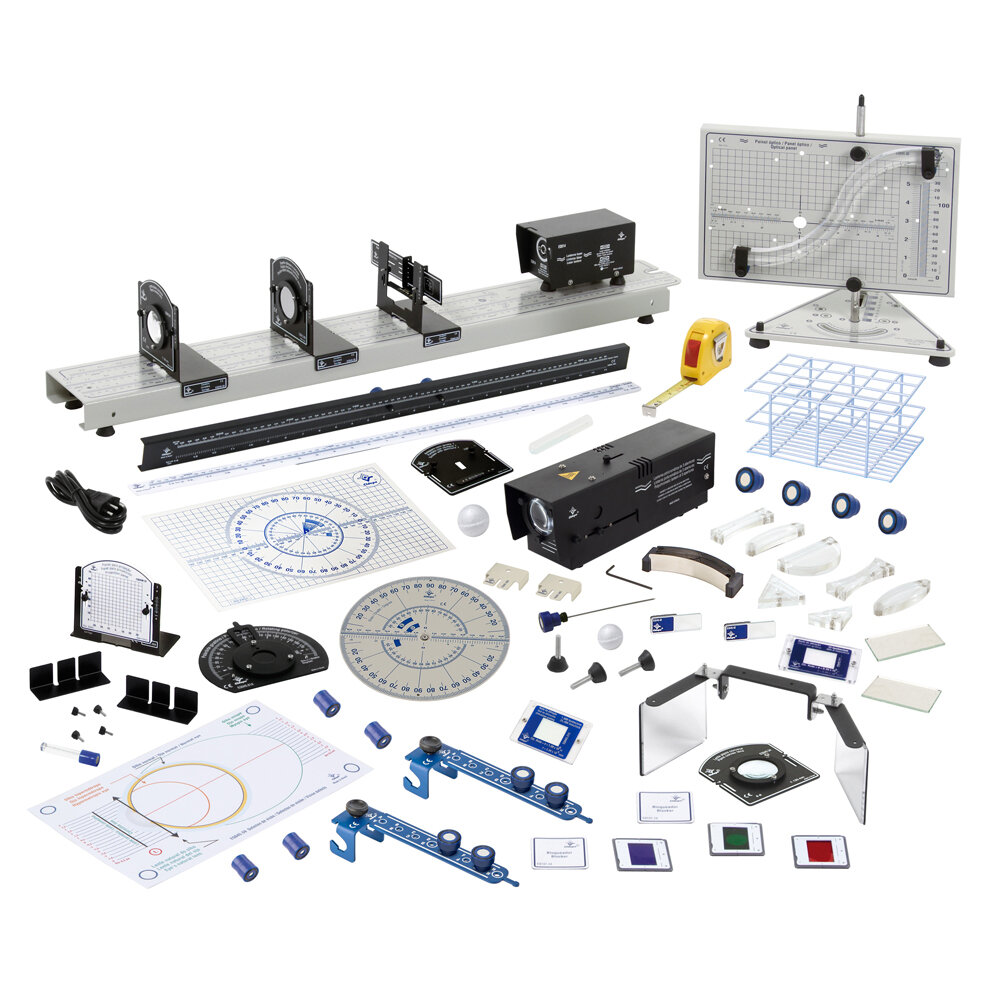
Intended for experimental study, physics laboratory work, and conducting physics experiments on: Physics. Light and optics. The principles of geometric optics. Transparent, translucent, opaque, homogeneous, and isotropic media to light. Principle of geometric optics. Simulation of solar and lunar eclipses, umbra and penumbra. Reflection in a plane mirror. The angle of incidence. The angle of reflection. The laws of reflection. The angle of rotation of the reflected ray. Where the image is formed in a plane mirror, a virtual image, plane diopter. The distances and size of the object and the size of the image formed in a plane mirror. The number of images formed between two plane mirrors at an angle to each other. Reflection in concave and convex spherical mirrors. The vertex, focus, real focus, focal length, and center of curvature of the concave mirror. Principal axis, secondary axes, aperture angle, and real aperture of the spherical mirror. Characteristics of the three principal rays of the concave spherical mirror. Caustic in a concave spherical mirror. Convex mirror, curved convex mirrored diopter. The focus and focal length of a convex spherical mirror. Characteristics of the three principal rays of a convex spherical mirror. The refraction of light and its laws, the diopters. The point of incidence, the incident ray, and the refracted ray. The angle of incidence and the angle of refraction. The refraction of light when passing from a less dense medium to a denser medium. The angle of incidence and the angle of refraction. The critical angle, limiting angle of refraction, and total reflection. Total reflection and optical fibers. The refraction and dispersion of light in optical prisms. Spherical lenses and their main characteristics. What is a lens? The three principal rays of converging lenses, positive lenses. The characteristic of the light ray contained in the optical axis of a lens. The real focus. The three principal rays of diverging lenses, negative lenses. The virtual focus. The lens and its vergence, convergence, or diopter. The relationship between the object, the lens, and the image generated by the lens. The Gaussian reference frame. Information according to the Gaussian reference frame for spherical lenses. The conjugate points function, Gauss's equation. Vision defects, the correction of ametropia, hyperopia, and myopia with lenses. The construction of some optical instruments. The conjugate image. Transverse linear magnification. Modern physics. Light and physical optics. Measuring the average wavelength of the colors of the continuous light spectrum, diffraction. Electromagnetic spectrum. Visible electromagnetic spectrum, light. Diffraction and Huygens' principle. Recalling light interference, Young's double-slit experiment, and the wavelength of light. Determining the wavelength of light considering the central maximum and secondary maxima. Observing and classifying the colors of the white light spectrum. Determining the wavelength of red radiation in the white light spectrum. Determining the wavelength of radiation of the other colors in the white light spectrum. Diffraction of laser light by a diffraction grating with a grating constant of 1.00 x 10⁻⁶ m. What does Huygens' principle state? Diffraction and Huygens' principle. Constructive interference points. Measuring the diameter of a fabric thread, diffraction, laser. Comparing the polarization of laser light with the polarization of polychromatic light. Light, light polarization, and the Polaroid. Plane-polarized light. Rayleigh scattering. What is meant by Rayleigh scattering or dispersion? The composition of colors derived by luminous superposition. Identifying primary colors. Identifying colors derived by luminous superposition of primary colors. The distortion in the color of an object due to the incident light used, etc.
Physics, light and optics.