
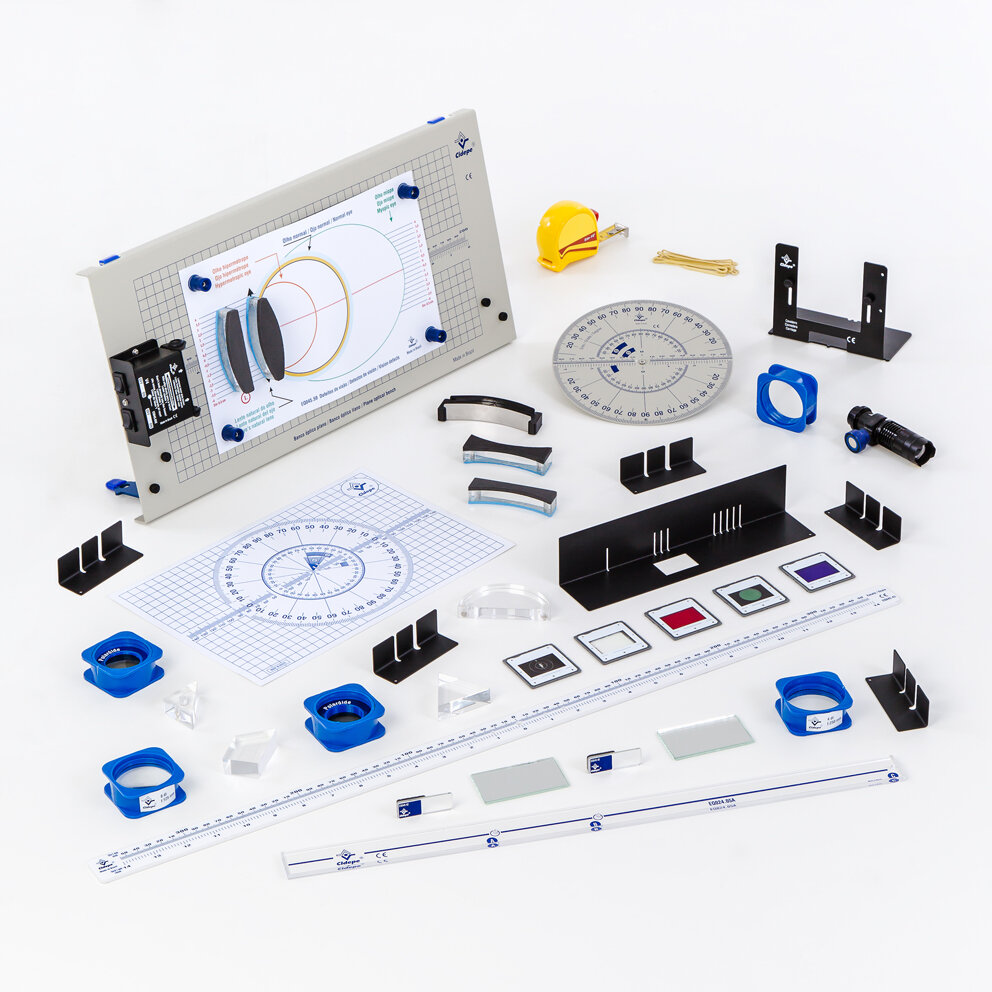
Intended for experimental study, physics laboratory and conducting physics experiments on: Light and optics. The principles of geometrical optics. Transparent medium. Homogeneous medium. Isotropic medium. Principles of geometrical optics. Principle of rectilinear propagation of light. Principle of independence of light rays. Principle of reversibility of light rays. The laws of reflection in a plane mirror. The image formed in a plane mirror and its characteristics. The distances of the object and the image from the plane mirror. The size of the object and the size of the image formed in a plane mirror. The number of images formed between two plane mirrors with an angle between them. Reflection in concave and convex spherical mirrors. The focus and focal length of the concave mirror. The principal axis of the spherical mirror. The three principal rays of the concave spherical mirror. The caustic in a concave spherical mirror. The focus and focal length of the convex mirror. The three principal rays of the convex spherical mirror. Refraction of light and its laws, dioptres. The incident ray and the refracted ray. The angle of incidence and the angle of refraction. The first law of refraction. The second law of refraction. The critical angle, limiting angle of refraction and total reflection. Total reflection. The Brewster angle. Brewster's law. Gauss's law, relationship between the object, lens and image. The Gaussian reference frame. The abscissas of the object and the image. The ordinates of the object and the image. Gauss's equation, equation of conjugate points. The transverse linear magnification (magnification). Classification of the image formed by the lens as a function of the sign of the transverse linear magnification. Refraction and dispersion of light (decomposition of light) in a 60-degree optical prism. The optical prism. Dispersion of white light as it passes through a prism. Identifying the colors of the spectrum of white light. Observing the phenomenon of polarization of light, Malus's law. Determining the average wavelength of the colors of the continuous spectrum of white light. Diffraction of light and Huygens' principle. The final diffraction pattern (light spectrum). Determining the average wavelength of different colors of the white light spectrum. Light interference, the Young double-slit experiment, the wave nature of light. The composition of colors derived by light superposition. The magnifying glass, an optical instrument. The optical microscope, an optical instrument. Building a microscope. Observing the object through the optical microscope. The conjugate image. Gauss's equation for spherical lenses. The distance between the conjugate image and the objective lens. The distance between the conjugate image and the eyepiece lens. Magnification, transverse linear magnification of a lens. Magnification, transverse linear magnification of the objective lens. Classification of the image formed by the lens as a function of the sign of the transverse linear magnification. Magnification, transverse linear magnification of the eyepiece lens. Total magnification or total transverse linear magnification, provided by the microscope. Magnification, transverse linear magnification of the optical microscope. The astronomical telescope, an optical instrument. Building an astronomical telescope. Observing the object through the telescope. Determining the visual magnification or angular magnification for the telescope. The difference between the astronomical telescope and the terrestrial telescope. Vision defects, correction of ametropias, hypermetropias and myopias, with lenses. Some refraction errors that the human eye may present, vision defects. Ametropia. Hypermetropia, or hyperopia. Myopia, etc.
Natural science, physics, light and geometrical optics.