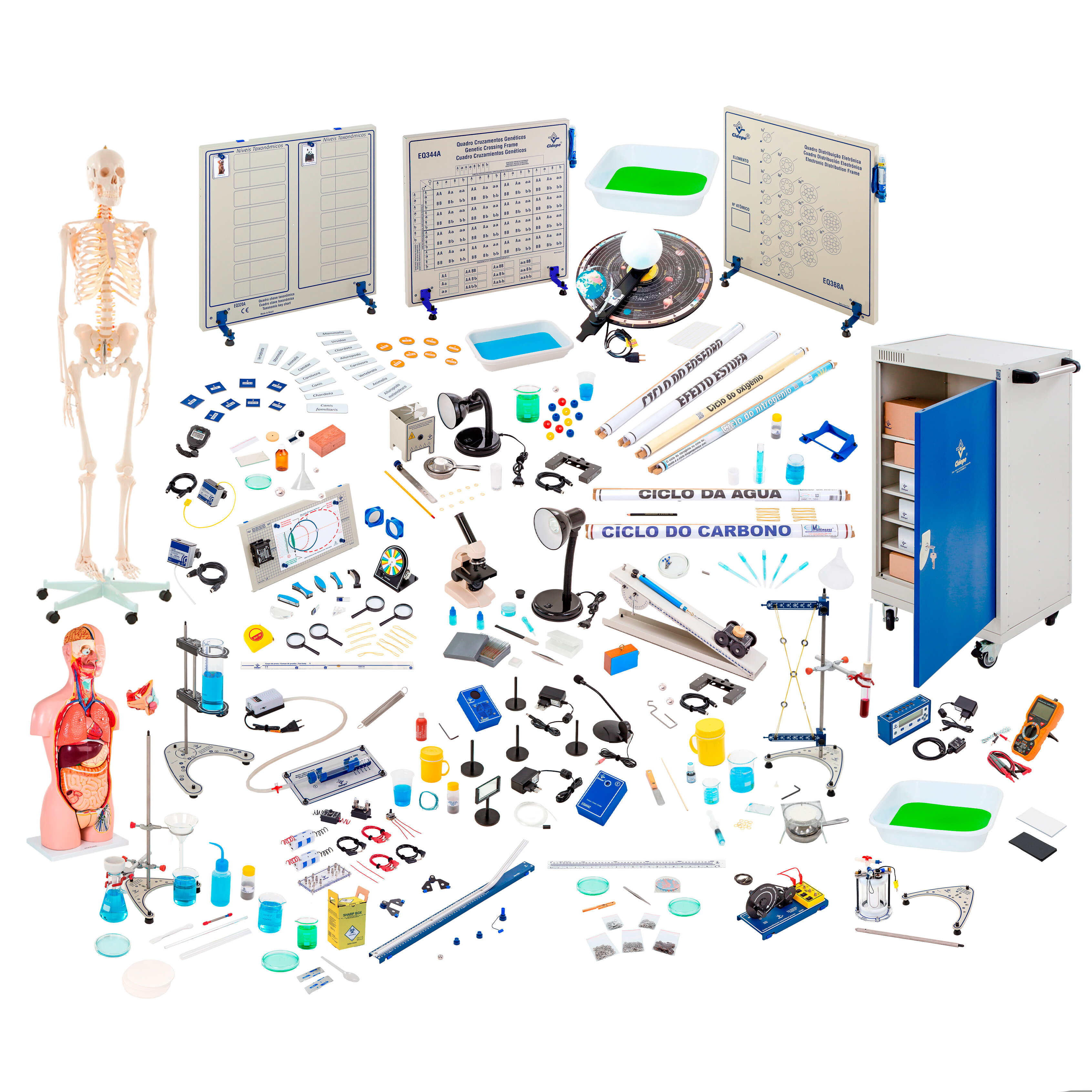
Intended for experimental study, a natural science laboratory, conducting science experiments on: BNCC (Brazilian National Curriculum Base). Matter and energy. Kinematics: motion, trajectory, and displacement. Cartesian reference system and physical quantities. Dynamics: frictional forces and Newton's laws. Statics: equilibrium and mechanical advantage on an inclined plane. Thermochemistry. Heat and temperature. Difference between heat and temperature. Thermal equilibrium. Expansion. Physical states of water and their transformations. Heat and energy. Conduction, convection, and radiation of heat. Difference between heat and temperature. Thermal expansion. Influence of color on insulation. Energy transformations. Heat and temperature. Air: energy, compressibility, and elasticity. Force, inertia, and deformations. Sound: low and high pitches. Light and transparency of materials. Separation of mixtures and use of magnets. Erosion and purification of water. Position and arrangement of objects. Electricity. Associations of lamps and resistors. Ohm's Law. Ohmic and non-ohmic resistance. Potentiometer. Mixed circuits and electrical power. Kirchhoff's laws. RC circuit, capacitor, and charging and discharging times. Light and optics. Properties of light and propagation media. Principles of geometric optics. Reflection and refraction of light. Plane and spherical mirrors. Angles and laws of reflection and refraction. Total internal reflection and Brewster's law. Vision defects and correction with lenses. Composition of colors on Newton's disc. Decomposition of light and dispersion of colors. Composition of white light as polychromatic light. Optics applied to telecommunications. Reflection and the law of reflection. Optical audio transmission. Demonstration of Total Internal Reflection in Optical Fibers. Wireless electronic communication using laser light. Characteristics of atoms. Electronic distribution of chemical elements. Structure of the atom, nucleus, and electron cloud. Atomic models. Quantum model and electronic configuration. Atomic orbitals. Pauli exclusion principle. Maximum number of electrons per energy sublevel. Gases and their transformations. Kinetic theory and thermal energy. Temperature and molecular agitation. Physical states of matter. Electrical energy and its sources. Renewable and hydroelectric energy. Earth and the Universe. Earth and its Translational and Rotational Movements. Solar illumination of the Earth. Earth's surface. Tectonic plates. The Earth and its interior. Solar and lunar eclipses. Measuring rainfall. Recording precipitation volume over a given period. Interpretation of meteorological data. Construction and analysis of precipitation graphs. Applications in natural sciences and geography. Life and evolution. Use of the monocular microscope. Observation of animal and plant histology slides. Ecology. Chlorophyll in green plants. Decantation and filtration in water purification. Separation of materials using magnets and recycling. Water quality analysis. Influence of the environment on the germination power of seeds. Evolution of living beings. Lamarckism. Darwinism. Synthetic theory of evolution. Classification of invertebrates. Structure and functioning of the monocular microscope. Identification of the parts of the microscope. Biogeochemical cycles. Water cycle. Carbon cycle. Oxygen cycle. Nitrogen cycle. Phosphorus cycle. Climate change. Greenhouse effect. Understanding the causes and consequences of climate change. Study of the water cycle. Genetic crosses with Punnett squares. Genotypes and phenotypes. Gametes and specialized cells. Sexual reproduction and mating. Gene transfer. Reginald Crundall Punnett and the Punnett square. Monohybrid cross. Dihybrid cross. Evolution. Natural selection. Homology between structures of different species. Gene selection in populations. Genetic variation in peas.
Natural sciences. Matter and energy. Life and evolution. Earth and the universe.