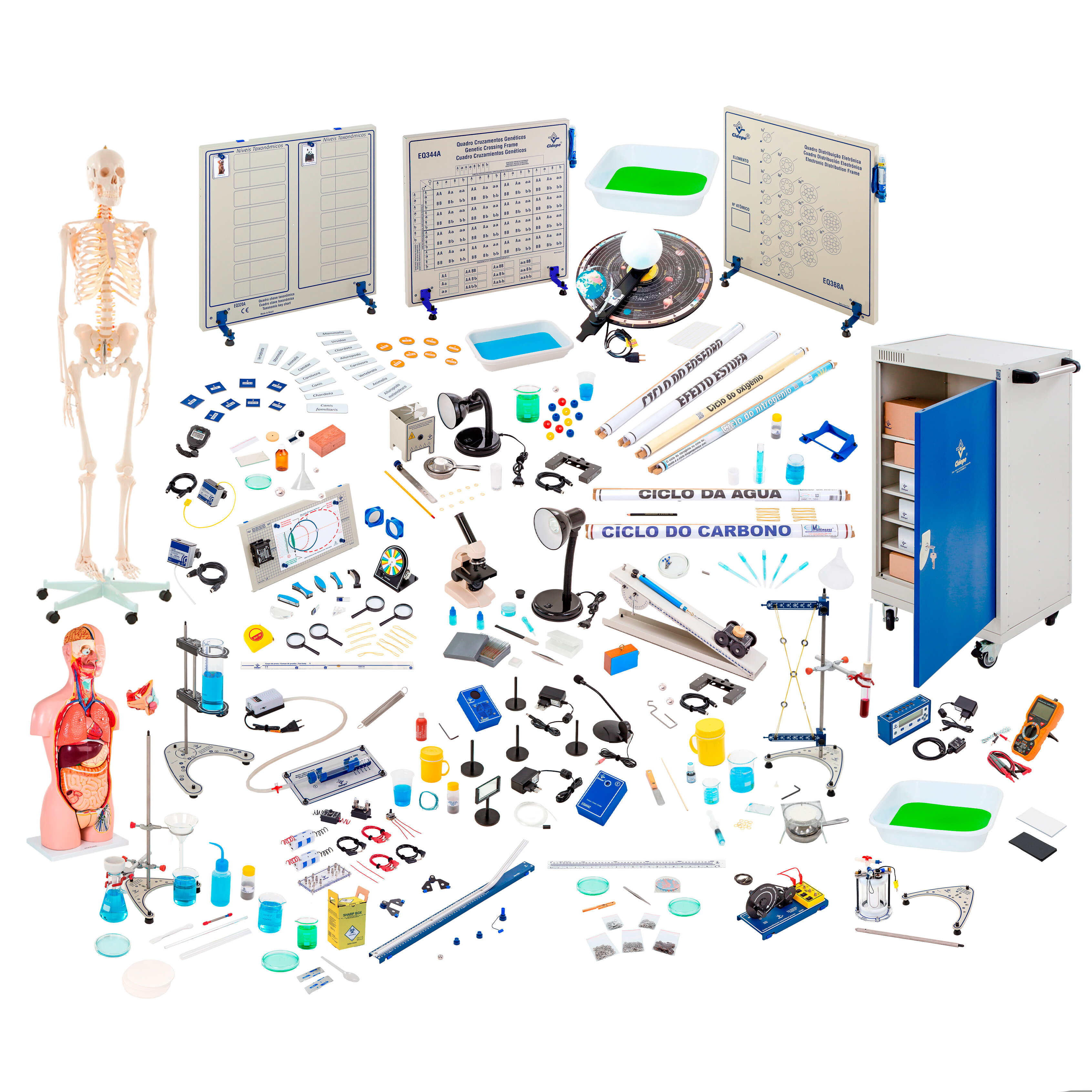
EQ321EF2
Main Experiments
-
Identifying objects by sound. — 0001.016
-
Differentiating between solid bodies, liquid bodies, and gaseous bodies. — 0001.030
-
The energy of moving air. — 0001.035
-
The condensation of water vapor contained in the air. — 0001.060
-
Change of physical state of water, melting. — 0001.065A
-
Soil erosion caused by the increase in water volume when it freezes. — 0001.070
-
The evaporation of water, the slow transition from the liquid state to the vapor state. — 0001.075A
-
Heat makes ice melt faster. — 0001.080
-
Producing oxygen through a chemical reaction. — 0001.125A
-
The condensation of water, the change of state from vapor to liquid. — 0001.190
-
Soil erosion caused by moving water. — 0001.195
-
Decantation and filtration are two steps in water purification. — 0001.200
-
Low-pitched sounds and high-pitched sounds. — 0001.270
-
Separating objects using a magnet. — 0001.275
-
Using magnets to separate materials, recycling. — 0001.276
-
The thermometer, an instrument that measures temperature — 0001.300
-
Observing the compressibility and elasticity of air. — 0001.330
-
Inertia, one of the general properties of matter. — 1032.002_1
-
Force, mechanical deformations, plastic deformation, and elastic deformation. — 1032.018
-
Light, transparent, translucent, and opaque mediums. — 1062.002
-
The thermoscope. — 1052.004B_1
-
— 1052.004C2_1
-
— 1052.008_A3B
-
The solidification of water, obtaining colored ice. — 1052.008_A4
-
— 1052.012B
-
Reference frame, position, movement, and trajectory. — 1032.001
-
— 1032.005B4JM
-
Frictional forces and Newton's first law of motion. — 1032.046
-
— 1032.048AB
-
— 1032.043AB2
-
— 1032.034AB1
-
The burning of a candle produces light and heat. — 0001.235
-
Conduction, a means of heat propagation, means of transmission, heat transfer. — 1052.024D
-
Convection, a means of heat propagation, means of heat transmission, heat transfer. — 1052.024D1
-
Radiation, a means of heat propagation, means of heat transmission, heat transfer. — 1052.024D2
-
The influence of color on thermal insulation. — 1052.024D3
-
Some energy transformations: electrical, luminous, thermal, and mechanical. — 1052.026D
-
Series and parallel lamp connections. — 1082.044A_2
-
Resistor combinations in series, parallel, and mixed configurations. — 1082.076A_3
-
Ohm's law. — 1082.056A_3
-
The potentiometer is a variable resistor. — 1082.084_2
-
Measurements in mixed circuits, electrical power, direct current. — 1082.092A_6
-
Kirchhoff's loop laws and kinematic laws. — 1082.076C
-
The RC series circuit uses direct current. — 1082.131A
-
— 1082.177_B
-
— 1082.177B
-
— 1032.041A
-
— 1062.003L1_0
-
— 1062.003L2_0
-
— 1062.003L3_0
-
— 1062.003L4_0
-
— 1062.003L5_0
-
— 1062.003L6_0
-
— 1062.003L7_0
-
— 1062.003L8_0
-
The composition of colors on Newton's disc. — 1062.004R_4
-
An astronomical telescope, an optical instrument. — 1062.004H8C
-
How to use a monocular microscope. — 1505.011C
-
Observing prepared slides using a microscope. — 1505.012A
-
— 1505.002A
-
Chlorophyll, the substance found in most green plants — 0001.175
-
— 0001.362B1
-
How the environment influences the germination power of seeds. — 1481.436B
-
The basic structure of a monocular microscope. — 1505.010A
-
— 1505.011C1
-
Identifying the parts of a monocular microscope. — 1505.014A
-
— 1505.019
-
— 1505.021
-
How does the water cycle work? — 1505.170
-
— 1505.121
-
How does natural selection occur? — 1505.140
-
My arm, a whale's flipper, a horse's hoof, and a bat's wing: what do they have in common? — 1505.150
-
How is a gene selected in a population? — 1505.160
-
Are all peas the same? — 1505.190
-
The human skeleton — 1505.016D1
-
Internal organs, identification and function. — 1505.017A3
-
— 1232.015JM
-
— 1212.012_1
-
— 1212.012_2
-
How can heterogeneous mixtures be separated using vacuum filtration? — 1212.012_3A
-
— 1212.014_A_1
-
The vertical position. — 0001.020
-
The arrangement of objects on flat surfaces. — 0001.025
-
The electronic configuration of chemical elements, using the table. — 1232.035Q
-
The kinetic behavior of gases. — 1052.035S1
-
The influence of temperature on the atomic and molecular motion of a gas. — 1052.035S2
-
Models of the state of aggregation of matter. — 1052.035S3
-
Where are the bacteria? — 1505.017B
-
— 1505.019B