
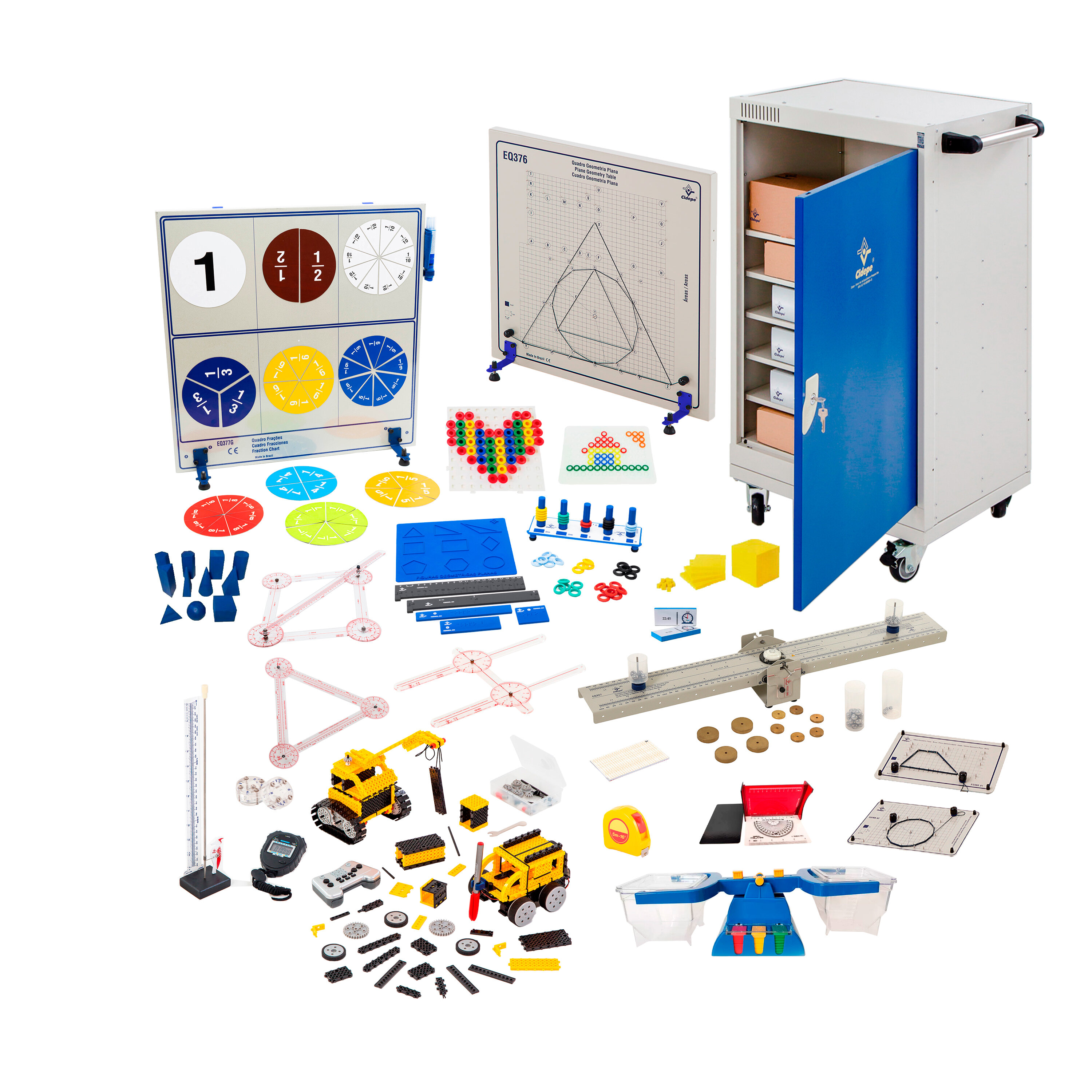
Intended for experimental study, mathematics laboratory and conducting experiments on: Mathematics. Trigonometry. The angular properties of triangles. The classification of triangles according to their sides. The property of the sum of the measures of the interior angles of a triangle. The property of the sum of the acute angles of a right triangle. The exterior angles of a triangle. The property of the sum of the exterior angles of a triangle. The property of the equality of each exterior angle with the sum of the adjacent interior angles. The fundamental trigonometric relations of the right triangle. The complementary interior angles of a triangle. The sine of an acute interior angle of a triangle. Measuring the sides of different right triangles. The tangent of an acute interior angle of a triangle. The two fundamental relations of the right triangle. The Pythagorean theorem, a metric relation between the sides of a right triangle. The law of sines and cosines in a right triangle. Constructing a triangle with known sides. Plane and metric geometry. Parallel, perpendicular and transversal lines. The open and closed polygonal line. Quadrilateral and trilateral polygons and their perimeters. The quadrilateral polygon (rectangle, square, parallelogram, trapezoid, rhombus) and the trilateral polygon (triangle). Congruence and congruent triangles. The diagonals of a polygon. Regular polygons inscribed in a circle. The geometric center and the apothem. The area of rectangles, squares, triangles, parallelograms, trapezoids, and rhombuses. Constructing polygons, determining areas, and discussing congruence. Algebra. First-degree equation with one unknown and the additive and multiplicative principles of equalities. Determining the mass of an object using a balance with equal arms. First-degree inequality with one unknown and the additive and multiplicative principles of inequalities. Ratio between two measurable quantities. The antecedent and the consequent. Proportion, constant of proportion, directly proportional relationship, and inversely proportional relationship. Inclusive education. Mathematics. Metrology. Significant figures and uncertainties. Measurement. Gross error, systematic error, accidental error, deviation, and relative percentage error. Mathematical operations with integers using the abacus. The number system. Addition and subtraction operations with integers. Probability. Probability in random events. Sample space, certain event, impossible event, complementary event. Expressions for calculating probabilities. Types of probability. Genetics. AND rule and OR rule in genetics. Circular fractions and equivalent fractions. Robotics. Concepts of mechanics, electrical circuits, electrical connections, and electronics with different assembly possibilities. Identifying directions and sense in the movement of a car. Determining the position of objects in the first quadrant of the Cartesian plane. Cartesian reference system in the plane. The quadrants. The coordinates of any point on the Cartesian plane. Position, movement, and trajectory. Trajectory and displacement. The difference between displacement and distance traveled. Energy transformation processes in the movement of a remote-controlled car. The main forms of energy available in nature. Direct current motor. Moving the car by remote control. Identifying different forms of energy involved in movement. The time function of movement. Determining a future position.
Mathematics: Rigorometry, plane and metric geometry, polygons, perimeters and areas, algebra, equations, inequalities, proportions, fractions, probability, metrology, and numerical operations.