
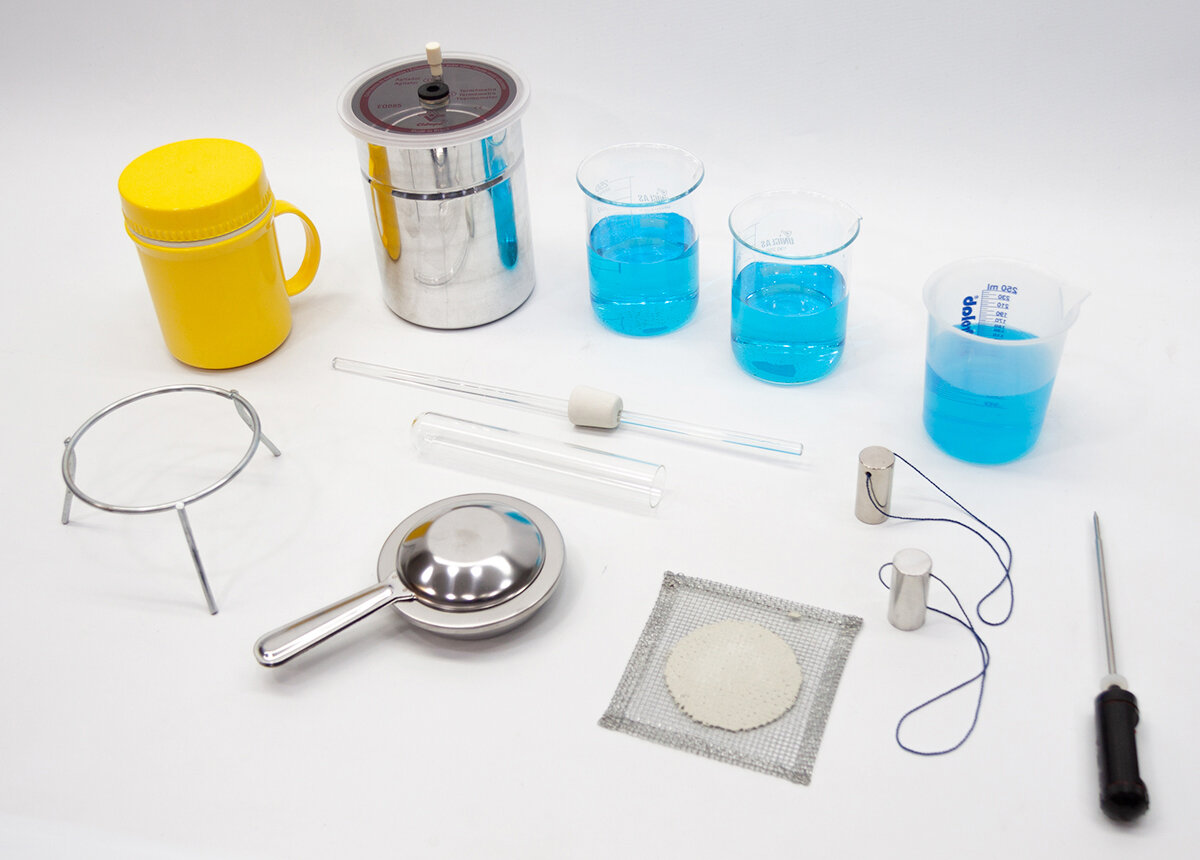
Intended for experimental study, physics laboratory work, and conducting physics experiments on: Thermodynamics, Calorimetry. The water equivalent and heat capacity of a calorimeter. What is a calorimeter used for? What is the water equivalent of a calorimeter? What is heat? Energy balancing, the principle of heat exchange. Measuring the final temperature, the thermal equilibrium temperature. Determining the water equivalent of the calorimeter. Determining the heat capacity of the calorimeter. The specific heat, mass heat capacity, of aluminum. What is specific heat? Measuring the final temperature, the thermal equilibrium temperature. Using the conservation of energy and the principle of heat exchange. Determining the specific heat of aluminum. Determining the specific heat, mass heat capacity, of steel. Measuring the final temperature, the thermal equilibrium temperature. Determining the specific heat of steel. The latent heat of fusion of ice. Using the principle of conservation of energy, the principle of heat exchange. Measuring the final equilibrium temperature. Determining the mass of ice by difference. Determining the latent heat of fusion of ice. The body's capacity to store energy in relation to heating time, mass, and volume of a material. The relationship between heating time and the mass of the same material. At the same temperature, equal volumes of different materials store different amounts of heat. Zeroth Law of Thermodynamics. Measuring the final temperature, the thermal equilibrium temperature of heated aluminum. Measuring the final temperature, the thermal equilibrium temperature of heated steel. Thermometry. The thermoscope. The difference between a thermoscope and a thermometer. Boiling point of water and freezing point of ice. Vaporization, boiling, and heating of water. Measuring the boiling point of water. Measuring the freezing point of ice, etc.
Thermodynamics, thermophysics and physical chemistry.