
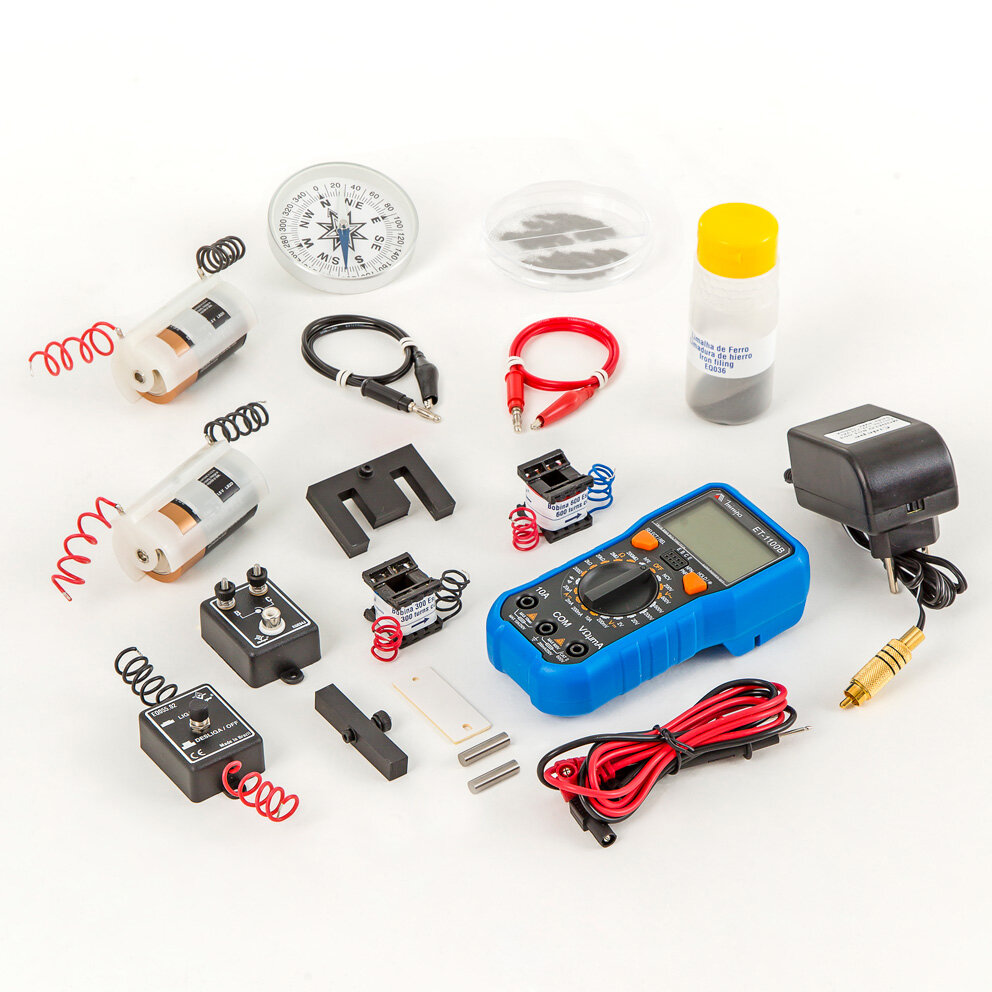
For experimental study of: Magnetism. The field lines and the magnetic field of the magnet, magnetism. What is meant by a magnet. Magnetism, magnetite, and the compass. Identifying the north and south poles of a magnet. The magnetic field, something invisible to the eye. Magnetic field lines, their properties, and what they indicate about the magnetic field vector. Magnets and their magnetic poles. The field lines of the magnetic field, in the region outside the magnet. What is meant by magnetization. Magnetization by contact. Magnetization by friction. The inseparability of a magnetic pole from a magnet. Repulsion between magnetic poles of the same name. Attraction between magnetic poles of different names. The spectrum between magnetic poles of different names. The spectrum between magnetic poles of the same name. Other magnetization processes. Electromagnetism. Oersted's experiment and electromagnetism, electromagnetic phenomena and electromagnetic induction. Oersted's experiment and electromagnetism. The right-hand rule for a straight conductor, which relates the orientation of the magnetic induction lines to the direction of the electric current flowing through the conductor. The electromagnet, a temporary magnet. Faraday's law, Lenz's law, Faraday-Lenz-Neumann law, electromagnetic induction, electromagnetic phenomena. Faraday's law of electromagnetic induction. Remembering magnetic field lines, their properties, and what they indicate about the magnetic field vector. The direction of the induced electric current depends on the direction of the variation of the source magnetic flux over the coiled conducting wire of the coil. Lenz's law of electromagnetic induction. The right-hand rule, which relates the direction of the electric current in the loops to the direction of the magnetic field induced by it. The Faraday-Lenz-Neumann law for electromagnetic induction. Temporary magnet, the electromagnet. Temporary magnets. Building a temporary magnet. The electric voltage transformer. Magnetic permeability. The electric voltage transformer, the primary, the core, and the secondary. Measuring the electric voltages in the primary and secondary of the transformer. Recording the numbers of turns contained in the primary and secondary. The relationship between the electric voltages in the primary and secondary and their respective numbers of turns, in an ideal transformer, etc.
Natural sciences, physics, electromagnetism.