
 Português
 English
 Español
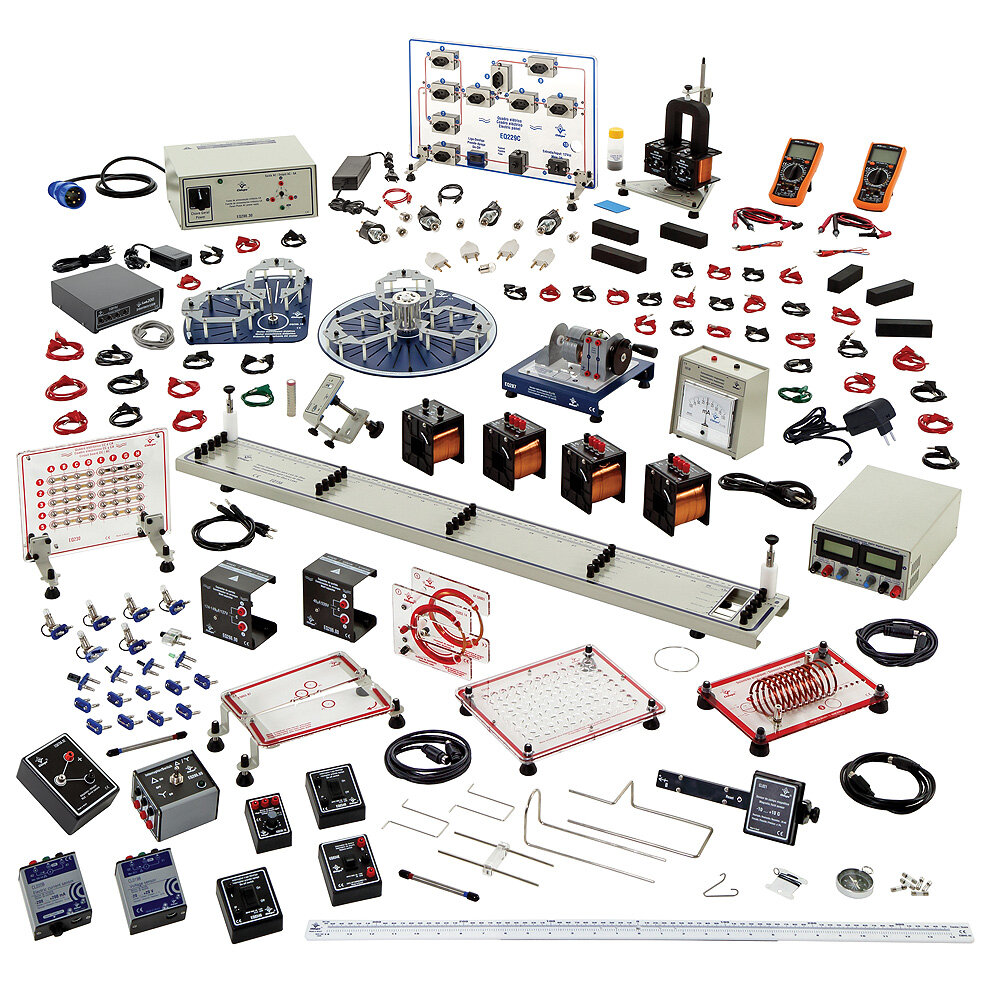
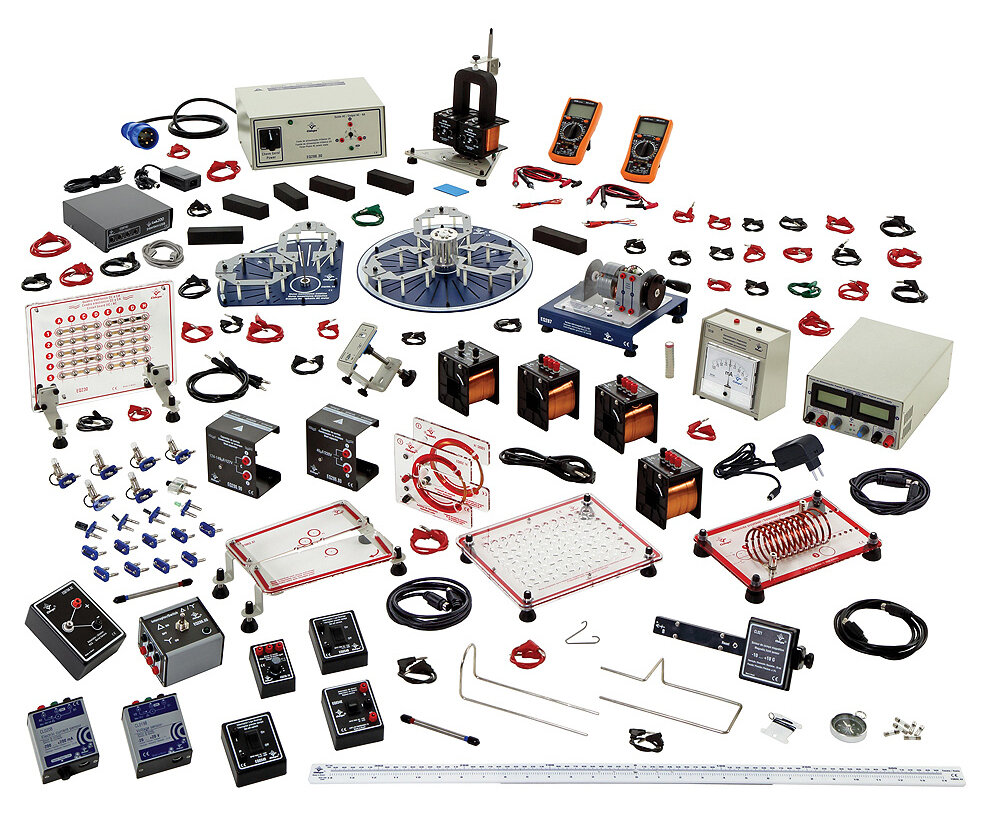
Electricity and Electromagnetism set
Code: EQ350C

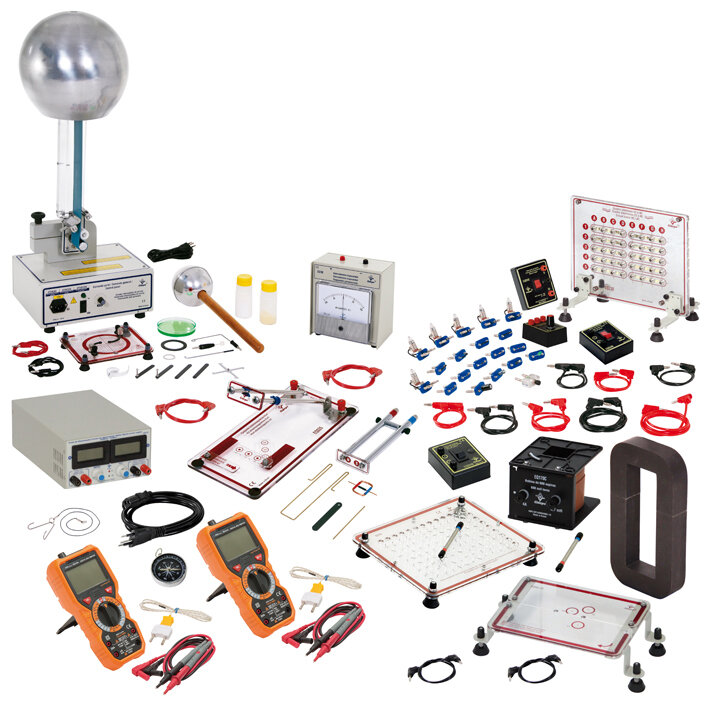
Function
Intended for experimental study, physics laboratory work, and conducting physics experiments on: Electrostatics. The tourniquet, the effect of the "electric wind," with the electrostatic generator. The operating principle of the leaf electroscope and the distribution of charges in a conductor. Discharge in air under atmospheric pressure. The cathode and anode electrodes in the Van de Graaff generator. The dielectric strength of a material. The electrical conductivity of a material. Gases, conductors of the third kind. Configurations of the lines of force between electrodes, the lightning rod, the Faraday cage, and the coaxial cable. Conservative fields. Michael Faraday, lines of force, and the electric field vector between two electrodes. Properties of the lines of force of the electric field. The lines of force between a pair of straight and parallel electrodes, between a pair of point electrodes, between a ring electrode and a centered point electrode, between a straight electrode and a point electrode, between two straight electrodes with opposite charges and a ring between them, the Faraday cage, electrostatic shielding. Electric potential and the work required to move an electric charge. The natural unit of electric charge and the quantity of electric charge. Measuring the potential on the outer surface of a sphere and the surface charge density of the sphere. The extension of the spark in a Van de Graaff generator and dielectric strength. Lighting a fluorescent lamp and a neon lamp without contact with the electrostatic generator. Making an "electric fountain". Simulating a lightning rod. Making your hair stand on end. Electricity. Electrodynamics. The association of lamps in series and in parallel. Identifying a resistor by its color bands. Electrical resistance, Ohm's law. Ohmic and non-ohmic resistors. The association of resistors in series and in parallel. Measurements in electrical circuits and electrical power. Measuring total current, voltage, and determining the power dissipated in the association formed by resistors. The mixed association of resistors. A way to measure the internal electrical resistance of a voltmeter and an ammeter. The function of the diode in a circuit. Kirchhoff's loop and node laws. The potentiometer as a voltage divider. The equivalent of a series and a parallel association of capacitors. Measuring the equivalent capacitance of the parallel association of capacitors. The RC circuit. The charging and discharging time of a capacitor. Magnetism. Identification of magnetic poles and lines of force in different magnetized objects. Magnetic field and terrestrial magnetism. Observing and drawing magnetic spectra and recognizing the region where the magnetic field is most intense. Permanent magnets. The magnetic field line. Magnetization by induction. Ferromagnetic substances. Magnetization by contact (friction). The repulsion between magnetic poles of the same name. The attraction between magnetic poles of different names. The magnetic spectrum between magnetic poles of the same name and between two magnetic poles of different names. Electromagnetism. Oersted's experiment and electromagnetism. What is meant by a compass rose and its use. Observing the phenomenon by reversing the direction of the electric current in the conductor. The right-hand rule, which relates the orientation of magnetic induction lines to the direction of the electric current flowing through a straight conductor. Electromagnetic phenomena and electromagnetic induction. Lenz's law and Faraday-Neumann's law. The action of the electromagnetic force on a conductor carrying an electric current, immersed in a magnetic field. Biot-Savart's law. The electromagnetic force acting on a moving conductor with an electric current, immersed in a magnetic field. A direct current electric motor, etc.
Quote product